World Bank upgrades Kenya’s 2026 economic growth forecast
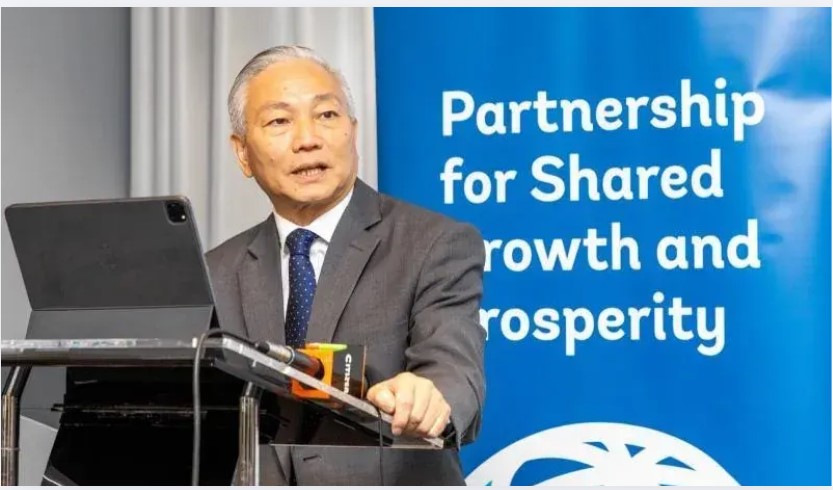
World Bank upgrades Kenya's 2026 economic growth forecast
The World Bank has revised its 2026 economic growth forecast for Kenya by 0.3 percentage points owing to stronger economic performance in the first half of the year.
In its Kenya Economic Update report released on Wednesday, November 4, 2026, the expected Gross Domestic Product (GDP) for 2026 was put at 4.6%, up from the 4.3% that was forecast in its July 2026 update.
According to the report, stronger growth in industry and services offset a slowdown in agricultural activity, helping the economy record a better performance than previously anticipated.
“Agricultural growth slowed to 4.2 per cent in H1 2026 from 4.7 per cent in H1 2025 (year-on-year), reflecting below-average short rains that weighed on crop production,” read the report in part.
“By contrast, industrial growth accelerated to 4.9 per cent from 4.3 per cent, supported by stronger construction activity (+6.3 per cent from +5.9 per cent), particularly in cement and galvanised sheet industries and improved manufacturing performance (+3.3 per cent from +2.1 per cent), driven by food and beverages production and vehicle assembly.”
Despite the improved outlook for 2026, the lender projects growth to decline slightly in 2027.
The report projects Kenya’s economy to expand by 4.4% in 2027. Notably, the country will be headed to the polls next year, and the report notes that political uncertainty poses a risk to the economy.
Specifically, risks of violence during and after the election period could impact investor confidence and the private sector in general.
“Election-related uncertainty, including the risk of violence and post-election disruptions, could weaken investor confidence, delay private investment decisions, reduce private and foreign investment inflows, disrupt tourism and trade, and weigh on economic growth,” read the report in part.
“Prolonged political contestation could slow progress in addressing Kenya’s underlying structural challenges.”
Public Service Commission exposes fake letters promising permanent govt jobs
Kwale residents return title deeds handed by Ruto over irregularities
KTDA appoints new board chairman
KCSE student dies moments after sitting first papers in Homa Bay
PSC warns CEOs over mishandling of civil servants’ disciplinary cases
TSC shortlists 5 candidates for CEO position (LIST)
At the same time, the international lender warned that the expected El Niño conditions could pose a risk to Kenya’s economic growth, particularly through their impact on agriculture.
World Bank explained that irregular rainfall could affect crop production, damage roads and other infrastructure, and cause fluctuations in food prices.
In cases of excess rains, flooding could also disrupt transportation and supply chains for food.
Cumulatively, these disruptions could push up the costs of food items and lower incomes for households that depend on agriculture.
However, this growth is projected to accelerate to 4.8% in 2028.
Meanwhile, the report also raised concern over the debt levels of the country, including the reliance on domestic borrowing, which was noted to be crowding out the private sector.
As of June 2026, the World Bank highlighted that Kenya’s public debt remained elevated at 69.9% of GDP.
Meanwhile at the same time domestic borrowing accounted for 56.2% of the total debt. Currently, Kenya’s outstanding debt stands at Ksh13.01 trillion.
Second body retrieved from Eastleigh building as rescue operation continues
Government announce recruitment of Chiefs and Assistant Chiefs
Don’t speak to me like I’m your child’ – Gachagua claps back at Matiang’i and Muturi
Nairobi lawyer abducted by masked men along Muchai Drive