Heavy Traffic Along Nairobi-Mombasa and Nakuru-Eldoret Highways Forces Motorists Spend a Whole Night
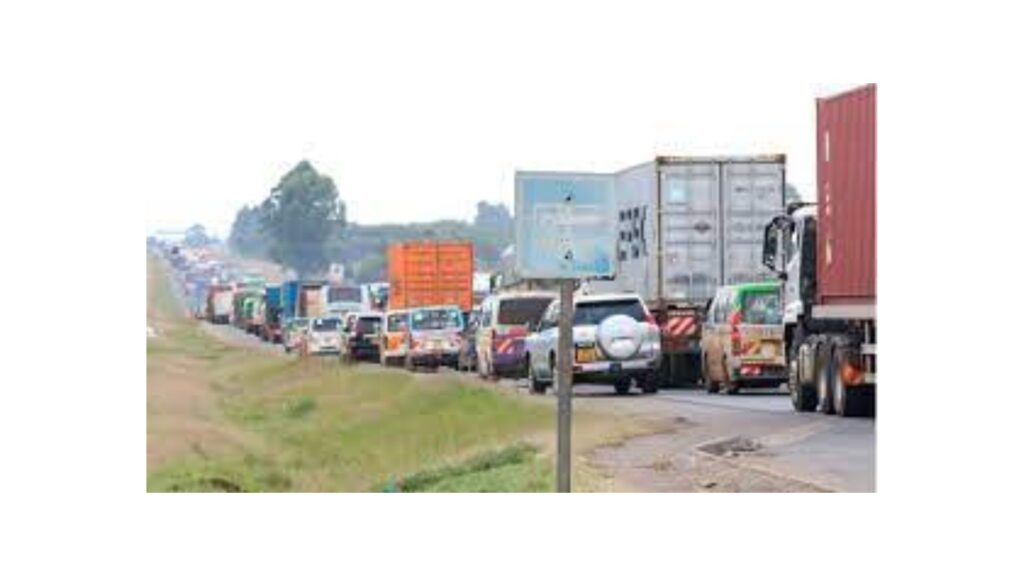
An Image of the Heavy Traffic Along Nairobi-Mombasa Highways
Hundreds of motorists endured a harrowing night on Kenya’s major transport corridors — the Nairobi-Mombasa and Nakuru-Eldoret highways — after massive traffic jams brought movement to a standstill from Friday evening through Saturday morning.
The worst jam was witnessed in the Nairobi-Mombasa highway adjacent to the Sultan Hamud area, Makueni County. The jam that started at about 8 p.m. on Friday soon reached several kilometers, leaving motorists and passengers stranded throughout the night. It was further compounded by the fact that vehicles overlapped and there was poor weather coupled with heavy rain slowing down traffic in both directions.
The police were brought out to control the situation, but were not successful since the list of the people with stranded vehicles was ever-increasing. Even at the beginning of Saturday morning, there were long queues of cars, public service vehicles (PSVs), and heavy trailers on the road, many drivers were not able to move even several meters during several hours.
ALSO READ
US Vice President JD Vance to Visit Kenya After G20 Summit in South Africa
Ten Charged in Paris for Cyber-Harassment Over False Gender Claims Against Brigitte Macron
Babu Owino, LSK Vice President Move to Court to Bar Cabinet Secretaries from Engaging in Politics
The same situation was witnessed at Nakuru-Eldoret highway where the traffic was completely stalled along Salgaa highway in Nakuru County. The jam was allegedly triggered by the collision that had blocked some of the one-carriageway. Some drivers were going into the wrong lane in an effort to avoid the blockage thus further increasing the gridlock. According to the police commander of Nakuru County Emmanuel Opuru, the night standoff was caused by both the accident and careless driving.
This was made worse by the heavy downpour that hit the Rift valley and other areas of the country. Drivers and passengers had no choice but to spend the night in their cars, enduring the cold and exhaustion unlike those who were in traffic, which continued several kilometers on either side of the road.
At Saturday morning, traffic conditions were excruciatingly slow. Granting a spot check, one could see that by 10 a.m., cars on both highways were barely moving. The videos filmed on the internet demonstrated that the tarmac appeared packed with vehicles, both little cars and matatus, as well as long-distance trucks, trying to navigate the situation.
According to transport analysts, this is because accidents bring out the much-needed road infrastructure to support the increasing volume of traffic in Kenya. Nairobi-Mombasa and Nakuru-Eldoret highways are among the busiest roads in the country which help to connect the capital city with the most important economic centers which include the port of Mombasa and the neighboring countries like Uganda.
Congestions as well as accidents are common along these routes and have in most cases derailed travel and commerce resulting into loss of money and frustration among the commuters.
The government has however, shown the intention to develop the road network in the country. In a recent reiteration by president William Ruto, there are plans to develop the major highways into multi-lane expressways to facilitate the movement of people and also improve the efficiency of transport.
During the opening of the Mau Forest Complex Integrated Conservation project on October 27, the President stated that the Rironi- Mau Summit road project will run westward up to Kericho and Kisumu where it will have another branch running to Eldoret and up to the Malaba border with Uganda.
The further development of these strategic routes is supposed to lessen congestion, enhance safety, and facilitate connectivity in the region in Kenya and the East Africa. In the meantime, though, the hours spent by motorists during the weekend can be used as a reminder that the country is in urgent need of infrastructure improvement and that the road improvement projects need to be implemented as soon as possible.