Protests Escalate in Madagascar as Citizens Demand President Rajoelina’s Resignation
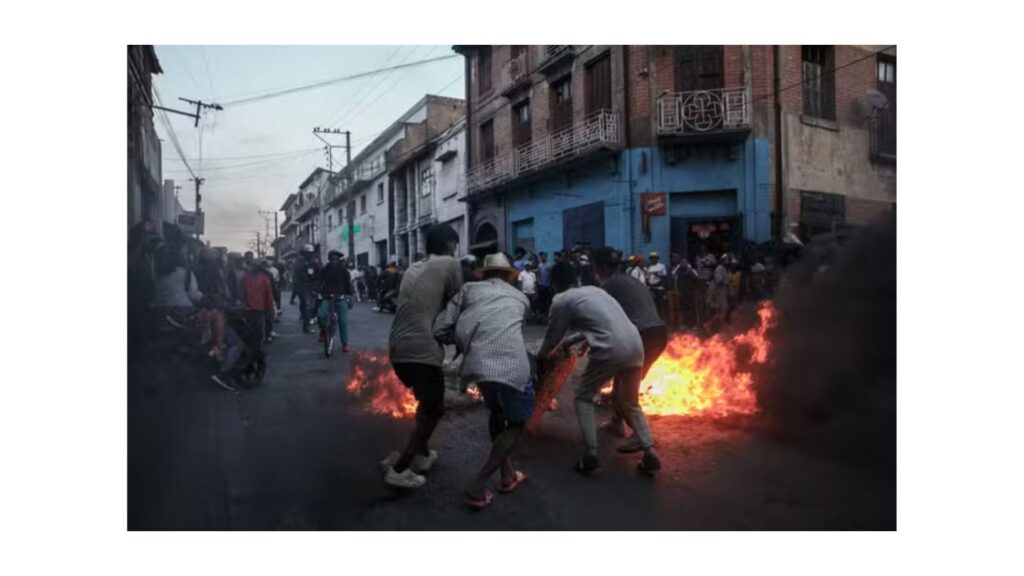
Group of demonstrators in Madagascar igniting fires on major roads
Demonstrations against the government have resumed in some of the key cities in Madagascar. The demonstrations are heading to the third week in a row. The demonstrators, mostly Gen Zs are urging the president, Andry Rajoelina to step down.
The demonstrations that started due to massive power and water disconnections have now turned into a larger movement that criticizes the government corruption, mismanagement of the economy and growing poverty in the island country.
Also Read
Madagascar’s President Reportedly Flees Amid Widespread Gen Z Protests and CAPSAT Military Defections
Venezuela’s Maria Corina Machado Wins 2025 Nobel Peace Prize for Defending Democracy
Russia Employs Mixed Signals in Effort to Revive the ‘spirit of Alaska’ Diplomacy with United States
Monday in the capital, Antananarivo, was dispersed with tear gas by police against hundreds of protesting people, including many university students. Students and young citizens have been in the forefront in organizing the rallies, witnesses claimed after being inspired by various recent protests by the “Gen Z” in Kenya and Nepal. The protests have since been extended to other cities such as Toliara in the south and Diego Suarez in the north and that is one of the most widespread waves of unrest that Madagascar has experienced in years.
Television coverage aired throughout the nation was of confrontations between police and protestors as demands that Rajoelina resign continued to increase. The president has not yet resigned even though the unrest has been witnessed. Rather, he has reacted by firing his cabinet last week in what seems to many a move that is too little to quash public anger.
Madagascar with its high biodiversity and large reserves of minerals is still one of the poorest nations of the world. Based on economic statistics, the per capita income of the country has decreased by approximately 45 percent since the country gained its independence in 1960 as it separated with France. The increasing disparity between the natural resources of the country and the day to day struggles of the citizens has emerged as the major problem driving the protests.
The protests ex-erupted in the first place last month in reaction on the frequent blackouts and water shortage, however, it has since developed into a fully-fledged anti-government movement. Protesters blame the administration of Rajoelina to have forgotten about the welfare of the people, enabling corruption to thrive and not doing anything about the economic crisis which has left most of the families barely able to meet their basic needs.
According to the United Nations, during the initial days of the demonstrations, at least 22 people were killed and more than 100 were injured. The government has however challenged these figures claiming that the international observers and the local media have overcharged the figures.
President Rajoelina on a televised speech on Friday issued an apology to the complaints raised by the protesters and claimed that he was ready to listen and hold a dialogue. But he did not go as far as to respond to the calls of his resignation.
In a statement to Reuters over the weekend, the presidency spokesperson said that the president is still working on developing viable solutions to the everyday life of the citizens. The spokesman also alleged that some political groups are taking advantage of the movement to destabilization of the nation.
Rajoelina allegedly saw some of the civil society groups during the weekend and deliberated on the prevailing crisis. Nevertheless, the information about those discussions has not been disclosed. Other civil society groups refused to attend in the meantime citing reasons that the government is not willing to assure the protesters of their safety and release prisoners who have been incarcerated since the protests broke out.
It is observed that the protests are a major challenge to leadership of Rajoelina who has been subjected to increasing criticism ever since he assumed leadership in 2009 following a political coup. Though later on re-elected, his government has failed to fulfill economic growth and transparency promises.
With the unrest still growing, the international observers are calling on the two parties to exercise restraint and dialogue in order to prevent more bloodshed. But as the protesters assure that they will stay in the streets until Rajoelina is out, Madagascar seems to be on the threshold of a volatile state that may define the political future of the country in the coming years.