Venezuela’s Maria Corina Machado Wins 2025 Nobel Peace Prize for Defending Democracy
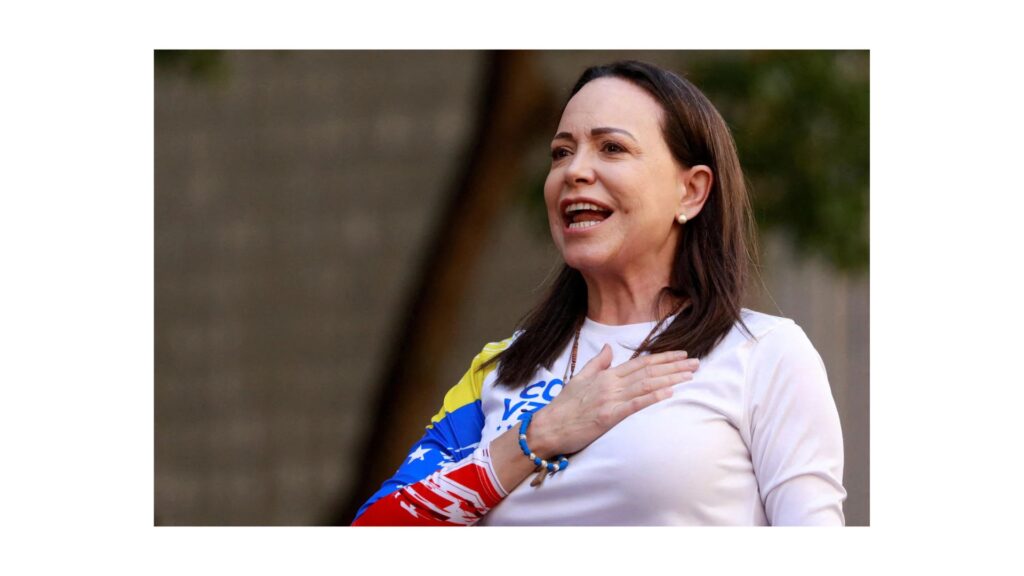
Apicture of the Venezuelan Opposition leadercMaria Corina Machado
Maria Corina Machado, the Venezuelan opposition leader has been given the world leading peace and humanitarian initiative. In a statement issued by its chair, the Norwegian Nobel Committee has said that it will award the 2025 Nobel Peace Prize to the industrial engineer and political activist, stating admiration at her unwavering and endless battle to enshrine democratic rights and a peaceful transition to democratic government in her native country.
The Norwegian Nobel Institute announced the award in Oslo, on Friday, pointing out that Machado was an outstanding example of civilian courage in the entire of Latin America.
Also Read
Russia Employs Mixed Signals in Effort to Revive the ‘spirit of Alaska’ Diplomacy with United States
Morocco’s Gen Z Protesters Rise Against Inequality and Demand Change
Cameroon’s 92-Year-Old President Paul Biya Seeks Eighth Term Amid Growing Calls to Step Down
Not only was she credited with her personal courage, but it was also her ability to bring together a divided political situation that was praised of the 58-year-old leader, who has been forced to live in exile in Venezuela because of constant threats.
The Nobel Committee in its official release stressed the fact that Machado was getting the award based on her unrelenting effort to introduce democratic rights to the citizens of Venezuela, as well as, her endeavor to bring about a just and peaceful change in the dictatorship regime to democracy. The statement also recognized the fact that she had been an important cohesive figure in a political opposition that had previously been deeply fragmented – an opposition that came to agree on the issue of free elections and representative government.
The award by Machado comes at a very long and bitter time of political crisis in Venezuela, when the incumbent President, Nicolas Maduro, is in power. It is now a critical moment in the political conflict that ran up to the 2024 presidential elections, with Machado becoming the consensus candidate of the democratic opposition. But, in one of the decisions that have been largely criticized by the international community, the Maduro administration used the courts to bar her candidature.
In spite of this political related disenfranchisement, Machado still remained the spiritual and strategic leader of the opposing movement and gave all the support to the alternative opposition candidate, Edmundo Gonzalez Urrutia. The following election has seen Maduro re-elected with an electoral vote of 51 percent of the total electoral votes in the country, his third electoral victory since he first took power in 2013 following the death of his mentor, former President Hugo Chavez.
The opposition, in its turn, instantly denied the outcomes, offering extensive evidence to the nation and the international community, which indicated mass fraud. They claimed that Maduro had failed to reach around 30 percent of the vote, and Gonzalez Urrutia had won rightfully, after taking the final result by a decisive margin according to the number of votes received by the two candidates in the independent count of votes in the elections nationwide.
The release of these discrepancies into the public only led to a surge of nationwide protests that required release of verifiable election results of individual polling stations. The government reacted very quickly and violently, which included crackdown on the opposition leaders and protesters.
The decision, made by Machado to stay in Venezuela in spite of the great personal risk and the fact that she had been already forced into hiding after grave threats to her life were discussed, was particularly praised by Jorgen Watne Frydnes, who was the chair of Norwegian Nobel Committee. Frydnes also proposed that her decision to remain and fight had inspired millions of people, with a critical message. He also wrote on the choice to reward her that in taking power, it is essential that the authoritarians should acknowledge brave champions of freedom, who stand up and object.
The international community rejoiced with the recognition. The office of the United Nations High Commissioner of Human Rights (OHCHR) through its spokesperson Thameen al-Kheetan congratulated Machado on the award. According to al-Kheetan, this acknowledgment is a reflection of the unambiguous desires of the people of Venezuela to free and fair elections, to civil and political rights and rules of law.
Machado will also be awarded the Nobel Peace Prize which is accompanied by a monetary gratuity of 11 million Swedish kronor (which is about 1.2 million dollars) in Oslo on the 10th of December. This day is marked in honor of the birth date of Alfred Nobel, the Swedish industrialist, the originator of the awards.
The committee in its statement also restated the mission of the prize saying that it has always been the mission of the prize to honour brave women and men who have risen up against repression, who have smuggled the hope of freedom into prison cells, onto the streets and in the public squares and whose actions have demonstrated that peaceful resistance can transform the world.
Machado is now in a line of the eminent list of laureates who have shown their remarkable dedication to human rights and peace. Iranian human rights activist Narges Mohammadi won in 2023 and Congolese humanitarian Denis Mukwege followed in 2018 and former United States President Barack Obama won in 2009.
Her victory is in sharp contrast to the speculative commotion that usually surrounds the announcement, especially this year where President Donald Trump had publicly and repeatedly claimed his own claim to the prestigious award, a claim that was eventually not to materialize by the committee. Her choice highlights how the committee emphasized grass roots struggle and resisting on principle rather than taking political office.